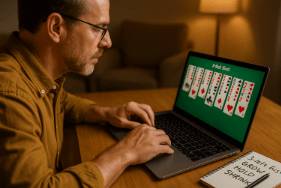
People who enjoy structured problem-solving often gravitate toward games that reward foresight more than luck. That is exactly where the freecell card game stands out. Unlike faster, more reactive games, FreeCell asks you to assess the board, preserve options, and think several moves ahead. For players who like strategic challenges, it offers a compact but demanding mental workout.
Why does FreeCell appeal to people who enjoy strategy more than chance?
FreeCell appeals to strategic thinkers because nearly every deal is shaped more by decision-making than randomness. The full layout is visible from the start, so success depends on planning, sequencing, and avoiding careless moves. That makes the game feel closer to a logic exercise than a luck-driven card pastime.
The main difference between FreeCell and many other card games is transparency. You can see the cards from the beginning, which means you are not waiting for hidden information to rescue a weak plan. The challenge is to work with what is already in front of you.
That structure changes the nature of the game. Instead of hoping for a lucky draw, you weigh tradeoffs. Should you free a low card now, or preserve a column for a later sequence? Should you use an open cell immediately, or save it as a strategic reserve? These are small decisions, but they accumulate. Strong play comes from understanding that every move either expands or limits your future options.
For people who enjoy chess, logic puzzles, or process-heavy work, this is a familiar kind of satisfaction. The pleasure comes not from surprise, but from control. You study the system, form a plan, and test whether your reasoning holds up.
How does FreeCell train the kind of thinking used in real problem-solving?
FreeCell trains practical strategic thinking by forcing players to hold several possible move paths in mind, delay impulsive actions, and manage limited resources. Those same skills appear in everyday decision-making, especially in planning, prioritizing, and solving complex problems under visible constraints.
FreeCell is not just about moving cards neatly. It is about managing consequences. Every move must be judged not only by whether it works now, but by whether it improves the board two or three steps later. That makes the game unusually good at rehearsing a useful mental habit: thinking beyond the immediate move.
The game also rewards restraint. Many losses happen because a player makes the obvious move too quickly and blocks a better sequence later. Strategic players learn to pause, scan the board, and ask a more useful question: what will this move cost me?
That kind of thinking has value outside games. In work and study, people often face the same tension between immediate convenience and long-term efficiency. A rushed decision can create friction later. A deliberate one can preserve flexibility. FreeCell gives that lesson in a small, repeatable format.
There is a broader reason this matters. According to the American Psychological Association, switching between tasks can reduce productivity by as much as 40%. Activities that encourage sustained, single-task concentration can therefore serve as a useful counterweight to scattered attention. FreeCell does exactly that by narrowing focus to one visible problem at a time.
Can playing a game like FreeCell support cognitive sharpness?
A game like FreeCell can support cognitive sharpness in a modest, realistic way because it engages working memory, attention control, and planning. It is not a medical intervention, but research suggests puzzle-based digital games are associated with stronger memory-related performance and better resistance to distraction in some adults.
It is important to stay precise here. FreeCell is not a treatment for cognitive decline, and no simple game should be presented as one. Still, the mental processes it uses are meaningful. Players must track card positions, hold possible lines of play in memory, and resist distractions caused by tempting but unhelpful moves.
Research on puzzle-style digital games points in a promising direction. A 2023 study reported that older adults aged 60 to 81 who played digital puzzle games showed stronger working memory capacity and distraction resistance, with performance in some measures comparable to that of younger adults. That does not prove that FreeCell alone will produce the same outcomes, but it does support the broader idea that puzzle-based game play can align with valuable cognitive demands.
Another reason strategic games matter is that many adults operate below ideal conditions for sharp thinking. The CDC says adults need at least 7 hours of sleep per day, yet in 2022, the share of adults getting less than that ranged from 30% in Vermont to 46% in Hawaii. When attention is already weakened by fatigue, short, structured mental tasks may be more useful than passive screen habits that further fragment focus.
Why is FreeCell a better fit than passive scrolling for a mental challenge?
FreeCell is a better fit than passive scrolling when you want a mental challenge because it creates active engagement, clear boundaries, and measurable consequences. Instead of absorbing endless stimuli, the player works through a defined problem, which can restore focus and create a stronger sense of mental order.
Passive scrolling keeps the mind occupied, but not always usefully. It tends to pull attention in multiple directions at once. FreeCell does the opposite. It imposes limits, presents one coherent system, and rewards careful evaluation.
That difference matters because mental fatigue is often not caused by a lack of stimulation. It is caused by too much low-value stimulation. A strategic card game offers a more efficient kind of engagement. The player is not trying to consume more content. The player is trying to solve a problem.
FreeCell also has a beginning, middle, and end. That may sound simple, but it is one of the reasons the game feels satisfying. A finished game provides closure. Scrolling rarely does. One gives the mind a puzzle to complete; the other often extends the feeling of incompleteness.
This matters in a world where sedentary and screen-heavy routines are common. The World Health Organization reported in 2024 that 31% of adults worldwide were not meeting recommended physical activity levels, equal to about 1.8 billion people. A strategic online game is not a replacement for movement, but it can be a better cognitive use of screen time than habits that leave attention more scattered than before.
See also: Community-Based Safety Insights Into 9365040048 and Activity
When should strategic players use FreeCell for the best experience?
Strategic players get the most from FreeCell when they treat it as a focused challenge rather than background entertainment. Short sessions work best during mental fatigue, between demanding tasks, or when sharpening concentration, because the game rewards deliberate thinking and loses value when played carelessly or half-attentively.
The best time to play FreeCell is when you can give it full attention for a short stretch. Ten minutes is often enough. That is long enough to get immersed in the logic of the board, but short enough to keep the game fresh.
It also helps to approach the game with the right mindset. FreeCell rewards patience. Rushing usually leads to avoidable errors. Players who enjoy strategic challenges tend to get the most from it when they review the board carefully, preserve empty cells when possible, and think in sequences rather than isolated moves.
That is the core reason to try it. FreeCell does not rely on spectacle. It does not ask for speed or noise. It asks for judgment. For anyone who enjoys structured challenges, visible information, and the satisfaction of solving problems through careful planning, that is more than enough.


 By
By